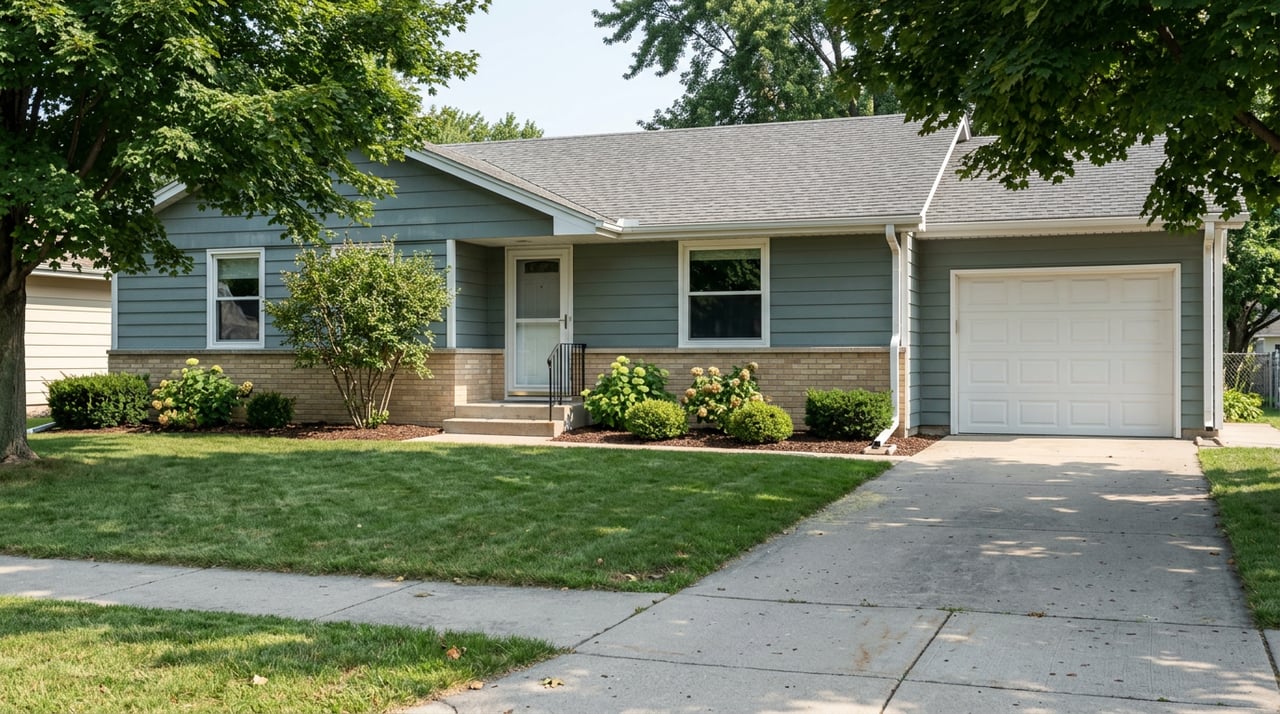
An appraiser pulls comps for a resale listing near Weaver Lake and comes back well under contract price. The seller's agent is confused. The buyer is nervous. Nobody did anything wrong. The house is fine. The problem is that the appraisal software pulled "sold in Maple Grove" as its search radius, and that search radius just as easily returns a brand-new executive spec home three miles away that still smells like drywall dust as it does a well-kept two-story from the late 1990s a block from the lake. Blend those two sales together and you get a number that describes neither house.
This is not a rare glitch. It is a predictable outcome of how Maple Grove's housing stock is actually organized, and it explains something buyers keep running into before they ever get near a closing table: the city's median home price depends entirely on which website you ask, and none of the three most common answers agree with each other.
Three Sites, Three Prices, Same City
Pull up Maple Grove on Redfin, Zillow, and Movoto on the same afternoon and you will get three different numbers, all technically correct.
Redfin's most recent published figures show a median sale price of $390,000 for February 2026, down 3.7 percent from a year earlier. Homes were taking about 53 days to sell that month, up from 29 days the year before, and only 56 homes closed that February compared to 65 the previous year.
Zillow's automated home value index for the city currently sits at $405,544, down 1.2 percent over the past year, with homes going to pending in around 15 days.
Movoto, tracking active listings rather than closed sales, shows Maple Grove homes listed to buy for a median price of $550,000 in August 2026, with a typical 43 days on market, roughly flat compared to the same month last year.
Three sources, three numbers that range from $390,000 to $550,000 for what is supposedly the same city in the same general window of time. The gap is not a data error. Each site is measuring something different: Redfin's number reflects what actually closed, Zillow's is a modeled estimate across the whole housing stock, and Movoto's reflects what sellers are currently asking for homes still sitting on the market. Those are three separate questions with three separate answers, and none of them tell you what a specific house in a specific pocket of Maple Grove is worth.
Why Sold and Listed Prices Are Pulling Apart
The more interesting number here is not any single figure. It is the direction of the gap. Sold prices are trending down. Active list prices are trending up. That divergence is a fingerprint of a city where two very different kinds of housing stock are moving through the market at the same time.
Maple Grove's Main Street district, the walkable core now known as Arbor Lakes, was built out in the neotraditional style between 1997 and 2001, with additional retail and residential phases following through the mid-2000s and a fourth major phase approved by the city council in 2016. Homes and townhomes in and around that established core, along with the neighborhoods near Weaver Lake and Fish Lake, are now twenty to thirty years old. That is the housing stock that closes most often and shows up in Redfin's sold-price median. It is also, generally, the stock that has softened the most as buyers weigh dated finishes against a new-construction alternative just a few miles away.
Meanwhile, the northwest side of the city, in pockets like Rush Hollow and the Rush Creek neighborhoods, is still actively being built out by national builders. That inventory sits on the active market longer while it works through construction and buyer decision cycles, and it lists at meaningfully higher price points than the resale stock closing across town. That is the inventory pulling Movoto's list-price median upward even as Redfin's sold-price median drifts down. The citywide "median" that gets quoted in casual conversation is an average of a twenty-five-year-old townhome near the Shoppes at Arbor Lakes and a spec home still under construction off Rush Creek, and it describes the purchase experience of neither buyer.
When the Border Isn't Where You Think It Is
There is a second wrinkle that makes this even more confusing for anyone searching online rather than working with someone who knows the map. Pulte's Territorial Grove community, now selling new construction from roughly $543,990, sits just across the city line in Dayton, near County Road 81, I-94, and Highway 610. Pulte markets the community on its access to Maple Grove schools, and it is drawing buyers who want the district and the daily orbit of Arbor Lakes shopping without technically living inside Maple Grove city limits. The community includes a brand-new elementary school scheduled to open in Fall 2026.
None of that inventory shows up in Redfin's, Zillow's, or Movoto's "Maple Grove" figures, because those platforms draw their boundaries at the actual city line. But a buyer casually searching for homes near Maple Grove schools will run straight into Territorial Grove listings anyway, and its pricing sits at the high end of what that buyer will see in the results. If you're comparing what you find online against the citywide median you read somewhere else, you may be comparing two different cities without realizing it.
Where the Blended Median Actually Costs You Money
The appraisal scenario at the top of this post is the clearest place where a blended median stops being an abstract inconvenience and starts affecting real numbers on a closing statement. When an appraiser or an automated valuation model pulls comparable sales for a specific address, the software is only as smart as the boundaries it's told to respect. A comp set that spans a 1999 two-story near Weaver Lake and a 2026 executive home near Rush Creek is not actually comparing similar things, even though both sales technically happened inside the same zip code.
There is a second, quieter version of this problem in the low-maintenance villa product built around Arbor Lakes and other townhome pockets across the city. Many of these homes carry a mandatory homeowners association that covers lawn care, snow removal, trash, and building exteriors. A villa priced close to a same-square-footage detached single-family home with no association is not actually the same purchase once you account for what the HOA dues are covering. Comparing raw price per square foot across those two products, without adjusting for what's bundled into the monthly dues, will make one option look like a better deal than it actually is.
If you are working from a CMA or reviewing an appraisal on a Maple Grove property, it is worth asking directly whether the comparable sales were pulled from the same general vintage, product type, and proximity, not just the same city. A same-district, same-decade comp set will tell you far more than a citywide median ever will.
What This Means If You're Comparing Neighborhoods
None of this means the citywide numbers are useless. They are a reasonable starting point for understanding direction: is the market cooling, is inventory loosening, are days on market stretching. Redfin's jump from 29 to 53 days on market year over year is a real signal that buyers have more room to negotiate than they did twelve months ago. What the citywide median cannot do is tell you what your specific offer should look like on your specific house in your specific pocket of the city.
The more useful question is not "what is Maple Grove's median home price" but "what is the median price for homes like this one, built in this era, in this part of the city, closed in the last few months." That is a narrower question, and it takes local knowledge to answer well, but it is the number that actually shows up on your settlement statement.
FAQ
Is Maple Grove currently a buyer's market or a seller's market? The city as a whole still leans toward sellers on paper, with homes historically selling close to asking price. In practice, conditions vary by pocket. Established resale inventory has been sitting longer than it did a year ago, while well-priced new construction in active building phases continues to move.
Why do some "Maple Grove" listings actually have a different city on the address? New construction near the city's edges sometimes sits just across a municipal line while still marketing itself on Maple Grove school access. Territorial Grove in Dayton is a current example. These homes will not show up in Maple Grove's official city-level sales data even though they compete for the same buyers.
How should I compare price per square foot between a townhome and a single-family home here? Check what the homeowners association covers before comparing raw numbers. A villa or townhome with lawn care, snow removal, and exterior maintenance built into the dues is not a true apples-to-apples comparison against a detached home with no association, even at the same price per square foot.
Reading a median price off a portal is a fine place to start. Knowing which submarket, which vintage, and which side of a city line your specific house actually belongs to is what determines whether that number has anything to do with your deal. If you're trying to make sense of what a Maple Grove home is actually worth, the team at Avenues & Acres Home Team can walk you through the comps that matter for your specific pocket of the city. Request Your Free Concierge Consultation to get started.