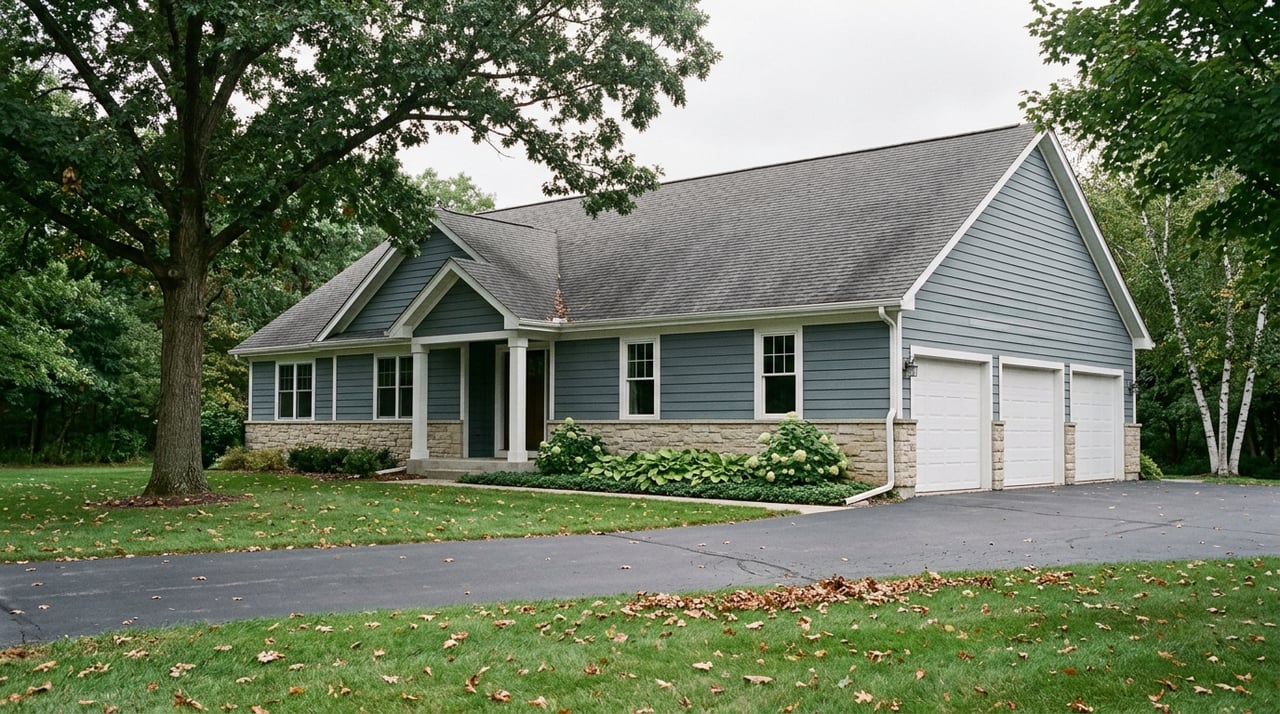
Picture two Orono listings priced within a few thousand dollars of each other. One sits on two and a half wooded acres down a private lane, no water anywhere in view, just mature trees and a long driveway. The other sits on a much smaller lot two blocks off Lake Minnetonka, close enough to hear boats on a summer evening but without a drop of shoreline to its name. Buyers touring both often assume they're paying for the same thing: an Orono address, an Orono school boundary, an Orono premium. They aren't. One of these homes is priced for land. The other is priced for proximity. Neither one is priced for water rights, because neither one has any.
That distinction gets lost when a buyer sees Orono's citywide median price on a portal and assumes it reflects lakefront scarcity. Most of what drives Orono's price floor upward has nothing to do with the lake at all. It has to do with a zoning code that has quietly required large lots across most of the city for years, whether or not the parcel touches water.
Same City, Two Different Products
Lake Minnetonka real estate breaks into tiers that matter more than the town name on the listing. True lakefront means the property line runs to the water, the owner holds riparian rights, and a dock application is at least possible under the Lake Minnetonka Conservation District's rules. Deeded or shared-dock access means an association or a neighboring lot owns the actual frontage, but the buyer gets slip rights without paying full lakefront price. Lakeshore-adjacent means a water view, maybe a short walk to a public access point, with none of the above. Three different products, three different price logics, and all three exist inside Orono's city limits.
Then there's a fourth category that gets overlooked because it doesn't sound exotic: the large inland lot with no lake connection whatsoever. In Orono, this category is bigger than most buyers expect, and it costs more than comparable inland acreage in neighboring suburbs. The reason isn't romance about the ZIP code. It's the zoning map.
What the Ordinance Actually Requires
Orono's zoning code sets minimum lot sizes by district, and several of the most common residential districts require far more land than a typical suburban buyer expects to need.
| Zoning District | Minimum Lot Area | Minimum Lot Width |
|---|---|---|
| R-1B | 0.5 acre | 100 feet |
| R-1A | 1.0 acre | 140 feet |
| RR-1B | 2.0 acres | 200 feet |
| RR-1A | 5.0 acres | 300 feet |
That table comes straight from Orono's zoning ordinance. None of it mentions shoreline. A home in the RR-1A district is required to sit on five acres by law, regardless of whether the nearest water is a quarter mile away or five miles away. The city's own accessory-building guidance adds another wrinkle worth knowing if you're weighing a fixer-upper or a future addition: lots under two acres are capped at 20 percent structural coverage, and an accessory dwelling unit is only permitted on parcels of at least one acre. Land isn't a lifestyle add-on in these districts. It's the baseline the code requires before a house can go up at all.
That baseline restricts supply. Builders and sellers can't subdivide their way around it. A five-acre RR-1A parcel can't be split into two and a half acre lots, because the district's own minimum sets the floor for any future plat, not just the original one. Fewer buildable lots, all of them large by mandate, pushes land cost upward independent of whatever's happening on the water that year.
Why the Median Keeps Moving Depending on the Month
If you've pulled Orono numbers from more than one source recently, you've probably noticed they don't agree, and the gap is wide enough to matter. A snapshot of active listings taken on September 11, 2026 showed 46 homes on the market with a median list price of $2.75 million and an average of $652 per square foot. Earlier in the year, a January 2026 read on closed sales put the median sale price closer to $1.1 million, with $276 per square foot. By May 2026, another market read placed the median list price near $1.5 million with $379 per square foot.
That's not a market swinging wildly month to month. It's three different samples pulling from three different mixes of inland acreage and true lakefront. When more five-acre RR-1A estates and lakefront trophies are on the market, the median and the per-square-foot figure climb. When more modest, smaller inland lots dominate the closed sales, the same statistics drop by half or more. A single "Orono median" is really an average of two markets that happen to share a city boundary, and depending on which month you check, one market or the other is doing the talking.
For a buyer, the practical takeaway is to stop asking what Orono homes cost and start asking what Orono homes in a specific district or a specific bay cost. A citywide median tells you almost nothing about what your own budget will actually buy.
A Pattern That Predates the Ordinance
This isn't a new dynamic. More than a decade ago, a Wayzata-based lake specialist told the Star Tribune that Orono's price tag has long reflected large lots and big houses as much as anything on the water, describing the town's draw as partly "an appreciation for living in a certain ZIP code." The zoning code has since formalized what was already a market habit. Large-lot exclusivity was already part of Orono's identity before it became a mandate written into Sections 78-230 and 78-395 of the city code.
Real estate professionals working the lake tend to sort the bays the same way. Wayzata Bay and Browns Bay carry some of the highest price per foot on the lake because they combine open water with a short walk into downtown Wayzata. Maxwell Bay and Crystal Bay, both partly within Orono, draw a different buyer entirely, one looking for privacy and acreage rather than a walkable main street. Both buyers might end up with an Orono address. They're not shopping for the same thing.
What This Means If You're Comparing Neighborhoods
If you're cross-shopping Orono against Wayzata, Plymouth, or Maple Grove using a single price-per-square-foot number, you're comparing apples that grew in very different orchards. A few adjustments make the comparison more honest:
- Ask your agent to split any Orono comps by zoning district, not just by city. An R-1B comp on a half-acre tells you almost nothing about pricing on a five-acre RR-1A parcel three miles away.
- If shoreline is the actual goal, evaluate the bay and the access type (true frontage, deeded access, or lakeshore-adjacent) before you evaluate the city name. Two Orono listings a mile apart can represent entirely different water rights.
- If acreage and privacy are the goal and the lake itself is secondary, recognize that Orono's inland lots were never going to price like inland lots in a suburb without the same minimum lot requirements. You're not missing a hidden discount. You're paying for a legal minimum that most nearby suburbs don't impose citywide.
- If your budget is fixed and the lake matters more than the acreage, it may be worth comparing zoning minimums suburb by suburb. Some communities ringing Lake Minnetonka don't require the same multi-acre inland lots Orono does, which can put actual water access within reach for less than an inland Orono estate.
None of this makes Orono a harder place to buy. It makes it a place where the listing price is answering two different questions at once, and knowing which question you're asking saves you from comparing the wrong numbers.
Frequently Asked Questions
Does the acreage minimum apply to homes already built on smaller lots? Older parcels that predate the current minimums are generally treated as legally nonconforming. The ordinance itself carves out adjusted setback language for "lots that are non-conforming as to their width," which assumes some existing lots in Orono sit below today's acreage and width floors. Confirm a specific parcel's status with the city's planning department before assuming what future additions or rebuilds would be allowed.
Can I get lake access in Orono without paying for true frontage? In some neighborhoods, yes. Deeded or shared-dock arrangements give a homeowner association or a defined group of properties the right to a slip on Lake Minnetonka without any one owner holding the actual shoreline. It's a real way to get on the water for less than full frontage costs, but it doesn't carry the same ownership or dock-application rights that come with true lakefront under the Lake Minnetonka Conservation District's rules.
Could a large Orono lot be subdivided to bring the price down? Only down to the district's floor. A five-acre RR-1A lot sits in a district with a five-acre minimum, so any future subdivision still has to produce parcels that each meet that number. The code sets the minimum by district, not by what a seller might prefer to carve off.
If you're weighing an Orono acreage lot against a smaller parcel closer to the water, or trying to figure out which bay actually fits your budget and your reason for wanting the lake in the first place, that's exactly the kind of comparison Avenues & Acres Home Team walks through with buyers every week. Request Your Free Concierge Consultation and we'll pull the district-by-district and bay-by-bay comps before you write an offer on the wrong kind of Orono property.