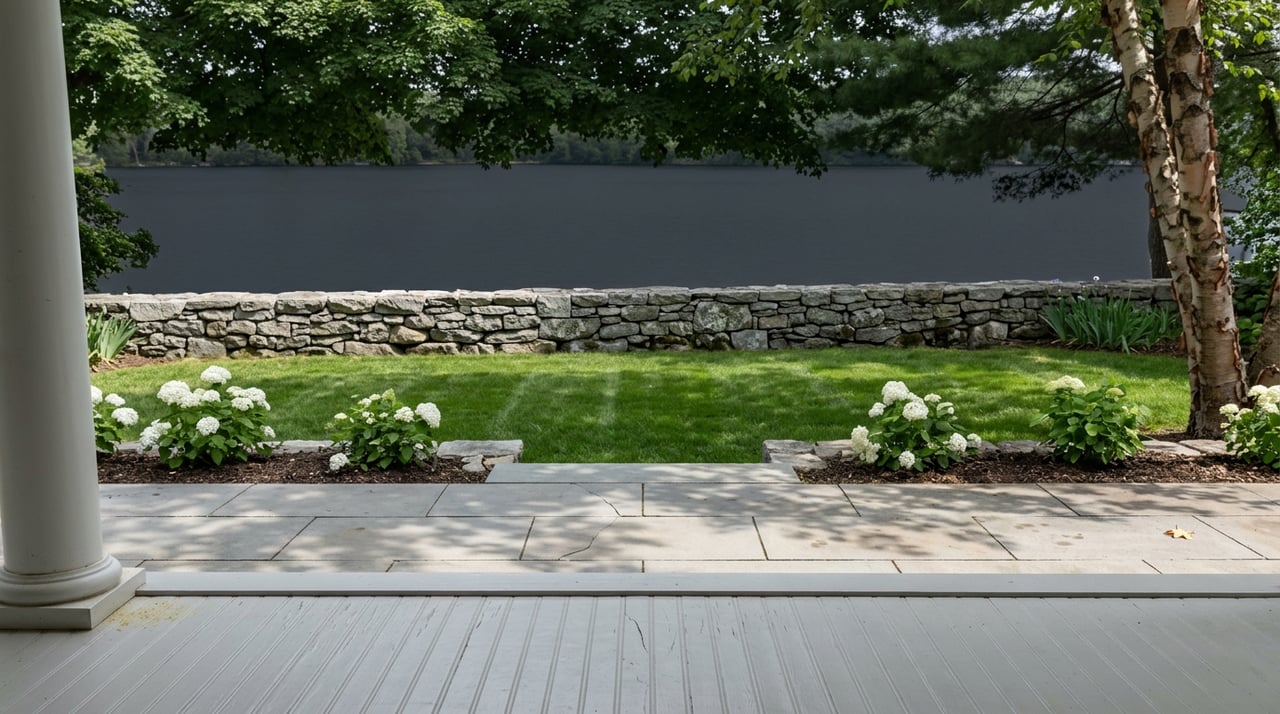
You are under contract on an Orono lakeshore home. The inspection is scheduled, the appraisal is ordered, and you are already sketching the addition, the new dock, and the guest cottage on a napkin. Then your surveyor calls with a number that does not match the one on the listing sheet, your lender asks for a septic compliance certificate, and someone mentions an ordinance you have never heard of.
This is the part of an Orono transaction the portals do not price. The median Orono sale in January 2026 came in at roughly $1.1M, while the May 2026 median list price sat near $1.5M, with estate and lakefront parcels frequently clearing $4M. The spread from inland to lakeshore is not really a spread in square footage. It is a spread in what four overlapping rulebooks will let you build, dock, and modify on the land you just bought.
The thesis is simple. On a Lake Minnetonka parcel in Orono, the price you pay is for the land you cannot touch, not the land you can. Understanding that before you remove contingencies is the difference between a good buy and an expensive lesson.
Rule One: The Build Line Your Neighbors Drew for You
Minnesota's shoreland program sets a 50-foot minimum structure setback from the Ordinary High Water Level on a General Development lake like Lake Minnetonka. Orono goes further. Under the city's shoreland code, formalized in Ordinance No. 313, the buildable line is often not measured from the water at all. It is measured off your neighbors.
The mechanic works like this. Orono's Average Lakeshore Setback draws a straight line between the most lakeward protrusions of the principal residences on the two immediately adjacent lots. Your new home, or any addition to the existing one, generally cannot cross that line toward the water. If the neighbor to your north sits 258 feet back from the shore because their lot happens to be deep and wooded, your practical build line can be pushed dramatically inland, even when the state's 50-foot minimum would technically allow a much closer footprint. Orono's own planning file for a Ferndale-area variance walked through exactly this scenario, with an applicant caught between a deeply setback neighbor and a nonconforming existing home.
Two documents settle whether this hurts you or not. The first is a current certificate of survey from a Minnesota Registered Land Surveyor, showing lakeshore, wetland, and side setbacks. The second is Orono's confirmation of the Average Lakeshore Setback line for your specific parcel. Ordinance 189, adopted in 2017, requires a foundation survey before framing and an as-built survey with hardcover calculations for any project in the Shoreland Overlay District. If you are buying with plans to expand, get the ALS line drawn before your inspection period ends, not after.
Rule Two: The Dock Is a Separate Transaction
Your dock is governed by a different agency than your house. The Lake Minnetonka Conservation District coordinates dock, watercraft, and shoreline rules across the 14 cities and two counties that touch the lake, and its Code does not automatically follow whatever your seller has been doing for the last twenty years.
Two numbers do most of the work. The LMCD uses a 1:50 rule, which allows one restricted watercraft per 50 feet of continuous shoreline measured at the 929.4-foot OHW elevation. Sites established before August 30, 1978 can store up to two watercraft regardless; sites established after can store up to four under conditions, and five or more triggers a formal license and generally requires at least 226 feet of shoreline. Everything must sit inside an Authorized Dock Use Area bounded by extended side property lines and length into the lake. Dock structures on shorelines longer than 60 feet may extend a distance equal to the shoreline length, capped at 100 feet.
Side-setback distances inside the Dock Use Area are worth committing to memory before you write an offer:
| Dock extends from OHW | Minimum side setback |
|---|---|
| 50 to 100 feet | 15 feet |
| 100 to 200 feet | 20 feet |
| Any length, if it includes a canopy | 20 feet |
Two more layers apply on the water itself. A 2023 LMCD rule requires slow-no-wake (5 mph) within 300 feet of any shoreline and 150 feet of docks, moored boats, and swimmers. The Hennepin County Sheriff's Water Patrol reported making educational and enforcement stops through the 2025 season, with continued enforcement into 2026 according to an LMCD update to the Shorewood City Council on May 26. If your daydream involves a wake boat leaving the dock at full throttle, that dream now lives 300 feet offshore.
Permanent docks installed with machine-driven pilings, dock extensions during declared low-water conditions, and most nonconforming legacy configurations still require permits or licenses. If the seller uses the word "grandfathered," treat that as a research prompt, not an answer. LMCD processing runs 30 to 120 days depending on complexity, so a dock question raised at closing is a dock question answered next summer.
Rule Three: The Septic Question the Lender Will Ask Before You Do
Hennepin County is unusual. The county's own septic program page and Ordinance 19 both confirm that Hennepin does not require a septic inspection at property transfer. State law requires the seller to disclose septic information, and that is where the county's obligation ends. In much of the Orono corridor, Hennepin has also delegated permitting authority to the cities themselves. According to the county's program materials, delegated jurisdictions include Long Lake, Minnetonka Beach, Spring Park, Minnetrista, Mound, Maple Plain, Medicine Lake, and neighboring communities, meaning the rules and inspectors change as you cross a city line.
Here is the friction. Most lenders financing a home on a private septic system will require a compliance inspection anyway. And under MPCA rule changes that took effect January 11, 2021, that compliance inspection now requires the septic tank to be pumped empty first. A compliance certificate on an existing system is generally valid for three years, so a certificate dated 2022 will not carry a July 2026 closing. If the seller has a fresh certificate in hand, verify the date. If they do not, budget the pump-and-inspection into your due-diligence timeline before your financing contingency lapses, not after.
The same discipline applies to the private well if the home is not on municipal water. Minnesota's well disclosure statute is a separate document from the standard seller's disclosure, and a working well on an older lakeshore parcel can carry sealing obligations if a second, abandoned well is found on site.
Rule Four: The 25 Percent Ceiling on Everything Combined
The state shoreland rules cap total impervious surface coverage at 25 percent of the lot area, and that cap applies to every structure combined. House, garage, driveway, walkways, patios, pool decking, and any accessory buildings all count against the same ceiling. Orono's Ordinance 189 requires an as-built survey with hardcover calculations for lots in the Shoreland Overlay District, which means the number is not aspirational. It is measured, filed, and enforced.
On a small lakeshore lot, this ceiling arrives quickly. A buyer planning a pool, an expanded garage, and a wraparound patio on a modestly-sized parcel can find that the math simply does not close, even when the setback lines allow the footprints. The 25 percent number is why some Orono lakefront listings command a premium that seems disconnected from the house itself. A larger lot is a larger hardcover budget, and a larger hardcover budget is future optionality.
What the Four Rules Do to the Price Tag
Put the pieces together and the Orono market makes more sense. Redfin recorded six Orono sales in January 2026 at a $1.1M median with 64 average days on market, while Movoto's May 2026 snapshot showed 20 sales at a $1.5M median list and 39 days on market. Volume is thin because the buyers who clear diligence on a compliant parcel with a working dock envelope and hardcover headroom tend to close. The homes that linger are usually the ones where the ALS line, the LMCD Dock Use Area, or the septic status introduces a friction the buyer discovers late.
The interpreted version: the parcels that trade closest to ask are the ones where the four rulebooks already say yes. The parcels that sit are the ones asking the buyer to solve for a variance, a redesigned dock, or a full septic replacement before they can use the property the way the listing photos suggested.
FAQ
Can I add a deck to a lakeshore home that already sits inside the current setback? State shoreland rules allow deck additions on nonconforming structures without a variance only if there is no reasonable alternative location, the encroachment does not exceed 15 percent of the existing shoreline setback, and the deck does not come closer than 30 feet to the OHWL, whichever is more restrictive. Local rules in Orono can be tighter, so start with the city planner.
Does a shared dock change the LMCD math? Yes. Multiple-family or shared configurations often require formal LMCD licensing, and the 1:50 shoreline rule applies to the combined frontage of the site. Verify licensing status in writing before assuming a shared dock conveys with the sale.
How long should I budget for lakeshore-specific diligence? Longer than a standard suburban transaction. Between a current survey with the ALS line drawn, an LMCD dock-use-area confirmation, a septic pump and compliance inspection, and a well disclosure review, a serious buyer should plan on a diligence window measured in weeks, not days.
Lakeshore transactions in Orono reward the buyer who reads the rulebooks before writing the offer. If you are working through a specific parcel and want a second set of eyes on the survey, the dock configuration, or the septic paperwork, Avenues & Acres Home Team offers a concierge consultation built for exactly this stretch of the market. Request Your Free Concierge Consultation.